
```html id="df2j3n" Teodora-Elena Bulichi

About me

I am currently a third-year PhD student in the Astrophysics Division at MIT, supervised by Prof. Christina Eilers. My research focuses on the early growth of supermassive black holes, combining observations, primarily from the JWST MEOW (#5407) and MOENCH (#6827) programs, which can constrain the early dust-enshrouded growth phases, with simulations I have developed to study black hole growth and the on-the-fly response of gas to ionizing radiation.

Before beginning my PhD, I completed an MPhys in Astrophysics at the University of Edinburgh in 2023. During my undergraduate years, I had the opportunity to work on several research projects that shaped my interests in both observations and simulations. Of particular note, a summer project at the European Space Agency as part of LEAPS, supervised by Dr. Katja Fahrion, introduced me to IFU observations and analysis. Later, my MPhys project with Prof. Romeel Davé introduced me to working with hydrodynamical cosmological simulations.

Before moving to Scotland for my undergraduate studies, I lived in my hometown in eastern Romania.
Research

Scientific motivation

Supermassive black holes (SMBHs) with masses reaching a billion solar masses already existed within the universe’s first billion years, posing a major challenge for early SMBH growth models. This tension is sharpened by observations suggesting that UV-bright quasar phases last about two orders of magnitude less time than standard accretion models require to build such massive black holes.

My research investigates early SMBH growth by combining observations and simulations, with the central question: how can black holes grow so rapidly if their observed quasar phases are so short?

Obscured SMBH growth with JWST

One possible way to ease the short quasar-lifetime tension is if early SMBHs grow predominantly during dust-obscured phases, making them largely invisible to UV-bright quasar surveys. In this scenario, the short lifetimes inferred from UV-selected quasars would trace only the relatively brief episodes during which UV radiation escapes, rather than the full period over which the black hole is actively assembling its mass.

In my research, I test this idea using mid-infrared observations from JWST. These wavelengths reveal the glow of dust heated by accreting SMBHs, even when the central engine is hidden at UV and optical wavelengths.

AGN obscured fraction redshift evolution
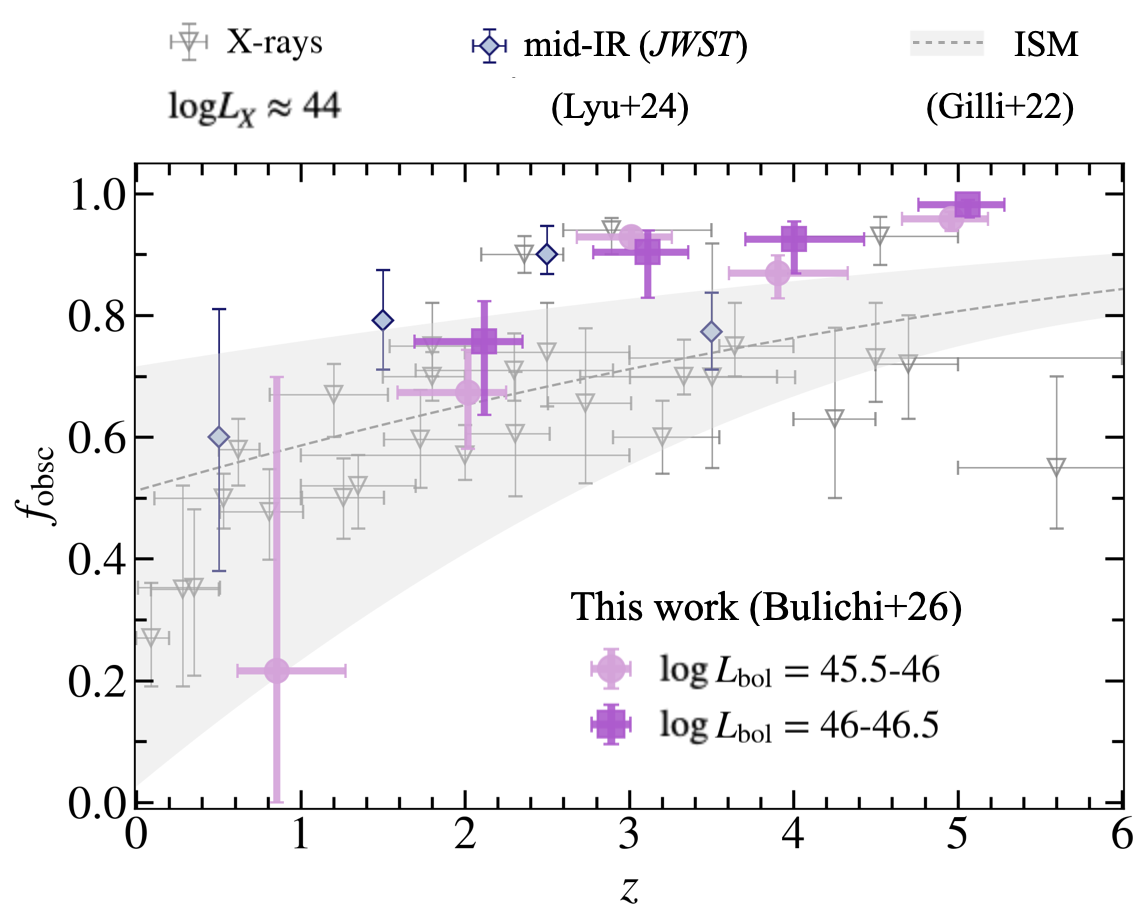
AGN obscured fraction redshift evolution, adapted from Bulichi+26.

In my 2026 paper, I used the JWST MEOW program (#5407) to identify AGN across cosmic time and compare their abundance to UV-bright quasars. This revealed a large population of obscured AGN missed by UV-selection methods, showing that much of early black hole growth may be hidden from traditional surveys. By quantifying the obscured AGN fraction, I found that obscured growth becomes increasingly important toward higher redshifts, reaching ~98–99% of AGN by z ~ 5, and offering a promising way to ease the short quasar lifetime tension inferred from UV/optical studies.

Looking ahead, I am excited to be involved in the JWST MOENCH (#6827) program, which combines mid-infrared MIRI photometry with HST and NIRCam imaging, as well as NIRCam/WFSS spectroscopy in F356W and F444W. This dataset will allow us to study obscured AGN in greater detail and place them in the broader context of early SMBH growth.

Radiation-hydrodynamical simulations

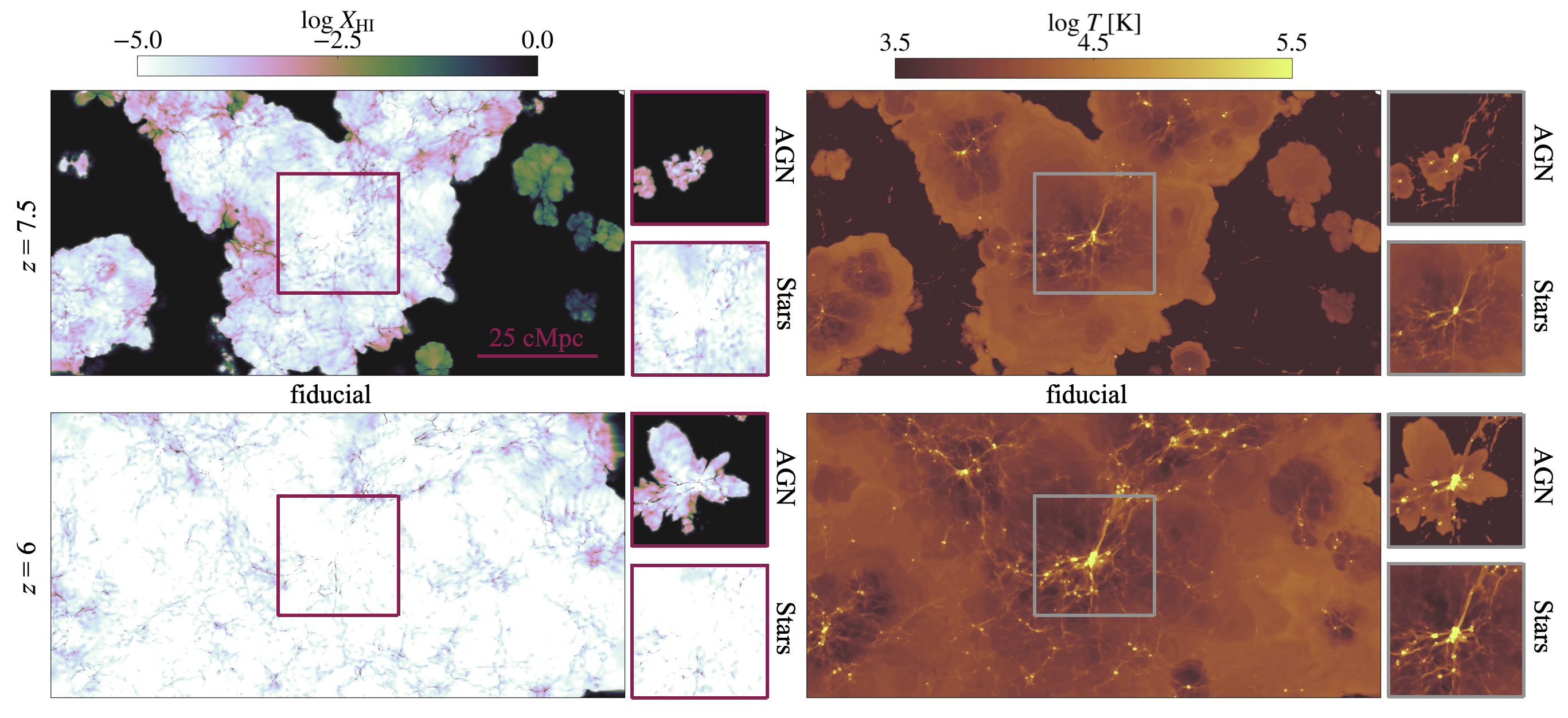
In parallel to my observational work, I have developed radiation-hydrodynamical simulations to study the growth of early supermassive black holes and their impact on surrounding gas. In my 2025 paper, I introduced simulations of high-redshift AGN populations that couple black hole growth, feedback, and radiative transfer on-the-fly, allowing the radiation field and gas response to evolve self-consistently. The AGN model introduced in this work was subsequently used in the Lumina simulations (PI: Oliver Zier).

Gas response to stellar and AGN radiation in simulations
Gas response to radiation at z = 7.5 and z = 6, highlighting the stellar and AGN contributions in the individual panels. Adapted from Bulichi+25.

Building on this framework, I am now extending these simulations to self-consistently study the effect of a luminous quasar, reaching Lbol ~ 1047 erg s−1 by z = 6, on the surrounding gas. By generating synthetic quasar spectra from the simulations, I will test whether small observed ionized regions (proximity zones) can arise from bursty, time-variable black hole growth, rather than requiring the entire SMBH growth history to be short.

Publications

My publication record includes a total of 7 papers, of which 4 are first-author publications and 1 is a second-author publication.
ADS library  |  ORCID

First-author publications

  1. T-E. Bulichi, G. C. K. Leung, A-C. Eilers, P. G. Pérez-González, G. Barro, S. L. Finkelstein, M. B. Bagley, A. M. Koekemoer, B. E. Backhaus, M. Dickinson, N. A. Grogin, D. D. Kocevski, R. A. Lucas, F. Pacucci, N. Pirzkal, E. Pizzati, J-T. Schindler, A. Traina, G. Yang: MEOW: The increase in the obscured AGN fraction in mid-infrared from 0 ≤ z ≤ 6 with JWST MIRI , eprint arXiv:2603.22393.
  2. T-E. Bulichi, O. Zier, A. Smith, M. Vogelsberger, A-C. Eilers, R. Kannan, X. Shen, E. Puchwein, E. Garaldi, J. Borrow: High-redshift AGN population in radiation hydrodynamics simulations , 2025, MNRAS, 544, 355.
  3. T-E. Bulichi, R. Davé, K. Kraljic: How galaxy properties vary with filament proximity in the Simba simulations , 2024, MNRAS, 529, 2595.
  4. T-E. Bulichi, K. Fahrion, F. Mernier, M. Hilker, M. Lyubenova, O. Müller, N. Neumayer, I. Martin Navarro, F. Pinna, M. Rejkuba, L. Scholz-Diaz, G. van de Ven: Expanding on the fundamental metallicity relation with dwarf galaxies and MUSE , 2023, A&A, 679, A98.

Second-author publication

  1. K. Fahrion, T-E. Bulichi, M. Hilker, R. Leaman, M. Lyubenova, O. Müller, N. Neumayer, F. Pinna, M. Rejkuba, G. van de Ven: Nuclear star cluster formation in star-forming dwarf galaxies , 2022, A&A, 667, A101.

Contributed-author publications

  1. O. Zier, A. Smith, X. Shen, R. Liu, R. Kannan, S. M. Koehler, V. Springel, R. Pakmor, M. Vogelsberger, T-E. Bulichi, L. Hernquist: Introducing the Lumina project: large-volume radiation-hydrodynamic simulations of the epochs of hydrogen and helium reionization , eprint arXiv:2605.15310.
  2. X. Shen, O. Zier, A. Smith, R. Liu, R. Kannan, T-E. Bulichi, S. M. Koehler, V. Springel, M. Vogelsberger, L. Hernquist, R. P. Naidu, A. de Graaff, E. Pizzati, D. M. Alexander, L. C. Ho, V. Kokorev, G. Leung, A-C. Eilers, R. C. Hickox: The Lumina Project: The Demographics of Active Galactic Nuclei from Quasars to Little Red Dots at z ≳ 3 , eprint arXiv:2605.24112.
```